
Welcome to the kingdom of wonders
Siem Reap Night Markets
Siem Reap night markets
If you love strolling, walking and eating at night
markets, then you'll have a wonderful time in Siem Reap. Several
bazaars open their doors around sunset, offering a broad mix of
stalls and booths, selling traditional Cambodian crafts, clothing,
silk, jewelry, paintings and other souvenirs.
 Souvenir shopping at Angkor Night
Market
Souvenir shopping at Angkor Night
MarketRecommended night markets
Siem Reap offers a wide range of night markets and thanks to the ever increasing tourist numbers, new ones are opening up regularly. Because of that, we created the following short list of night bazaars that are worth a visit. Each one of these has its own unique atmosphere, which will assure that you'll have a great and relaxing time.Angkor Night Market

Tel: +855 92 654
315
Opening hours: Every day from 16h00 till midnight
Location: On Sivutha Blvd, just 100m from Pub Street, follow the neon lights to find its location
Opening hours: Every day from 16h00 till midnight
Location: On Sivutha Blvd, just 100m from Pub Street, follow the neon lights to find its location
BB Night Market

Opening hours: Every day from
noon till midnight
Location: Between Pub Street and Sivutha Blvd
Location: Between Pub Street and Sivutha Blvd
Noon Night Market

Tel: +855 63 963 775
Opening hours: Every day from noon till midnight
Location: Between Sivutha Blvd and Angkor Night Market
Opening hours: Every day from noon till midnight
Location: Between Sivutha Blvd and Angkor Night Market
Siem Reap Art Center Market

Tel: +855 12 831
535
Opening hours: Every day from 20h00 to midnight
Location: Old Market area, on the east bank of the Siem Reap River
Opening hours: Every day from 20h00 to midnight
Location: Old Market area, on the east bank of the Siem Reap River
Natural Tours
Tonle Sap
Lake & Prek Toal Bird Sanctuary
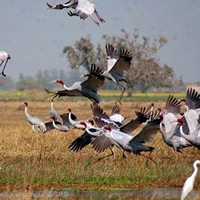 Cambodia’s
Great Tonle Sap Lake sits only 15 km south of town, a unique
eco-system and cultural area offering the opportunity to see
a different side of the Siem Reap - floating
villages, cultural and nature tours, birdwatching
Cambodia’s
Great Tonle Sap Lake sits only 15 km south of town, a unique
eco-system and cultural area offering the opportunity to see
a different side of the Siem Reap - floating
villages, cultural and nature tours, birdwatching.
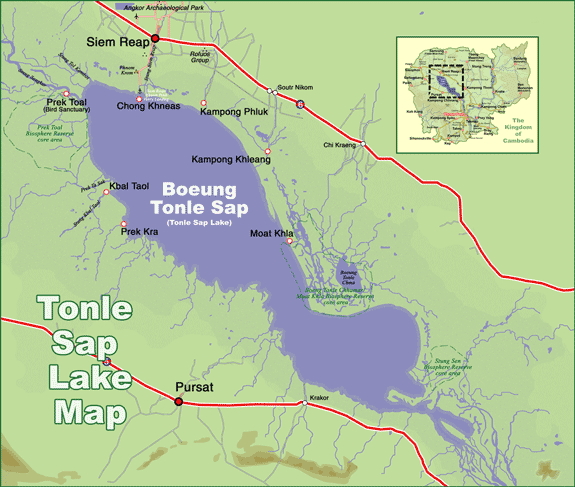
The Tonle Sap Lake is the most prominent
feature on the map of Cambodia - a huge dumbbell-shaped body of water
stretching across the northwest of the country. In the wet season, the
lake is one of the largest freshwater lakes in Asia, swelling to an
expansive 12,000 km2. During the dry half of the year it shrinks to as
small as 2500 km2, draining into the Tonle Sap River, which meanders
southeast, eventually merging with the Mekong River at the 'chaktomuk'
confluence at Phnom Penh. During the wet season a unique hydrologic
phenomenon causes the Tonle Sap River to reverse direction, filling the
lake.
The engine of this phenomenon is the Mekong
River, which becomes bloated with snow melt and runoff from the monsoon
rains. The swollen Mekong backs up into the Tonle Sap at the point where
the rivers meet at Chaktomuk, forcing the waters of the Tonle Sap River
back into the lake. The inflow expands the area of lake more than
five-fold, inundating the surrounding forested floodplain and supporting
an extraordinarily rich and diverse eco-system. More than 100 varieties of waterbirds
including several threatened and endangered species, over 200 species of
fish, as well as crocodiles, turtles, macaques, otter and other wildlife
inhabit the inundated mangrove forests. The Lake is also an important
commercial resource, providing more than half of the fish consumed in
Cambodia. In harmony with the specialized ecosystems, the human
occupations at the edges of the lake is similarly distinctive - floating
villages, towering stilted houses, huge fish traps, and an economy and
way of life deeply intertwined with the lake, the fish, the wildlife and
the cycles of rising and falling waters.
 Prek
Toal Bird Sanctuary
Prek
Toal Bird SanctuaryThe sanctuary at the Prek Toal core area of the Biosphere Reserve has been called "the single most important breeding ground in Southeast Asia for globally threatened large waterbirds." The Biosphere covers 31,282 hectares at the northwest tip of the Lake and plays host to species including Greater and Lesser Adjuncts, Black-headed Ibis, Painted Stork, Milky Stork, Spot-billed Pelican, Grey-Headed Fish Eagle and many more species. Of the three Biosphere core areas on the Tonle Sap Lake, Prek Toal is the most accessible from Siem Reap and the most popular with birdwatchers. The best time of year for viewing is the dry season (December-May) when flocks of migratory birds congregate at Prek Toal. As the dry season progresses and the water recedes, the number of birds increases but the travel to some of the more important viewing areas becomes more difficult.
Arrange a trip to Prek Toal through your guesthouse or a tour operator. To do it yourself, take a moto or taxi from Siem Reap to the Chong Khneas boat dock. Arrange a boat to the Prek Toal Environmental Research Station (starting at $60 return,) a $20 entrance fee and $30 for a guided boat tour of the sanctuary. The Research Station has information on the area's flora and fauna. There are also basic overnight accommodations if you want to stay the night to take full advantage of the sunset and early morning viewing hours.
 Chong
Khneas
Chong
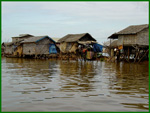
KhneasChong Khneas is the floating village at the edge of the lake closest and most accessible to Siem Reap. If you want a relatively quick and easy look at the Tonle Sap, boat tours of Chong Khneas are available, departing from the Chong Khneas boat docks all day long. Take a tuk-tuk or taxi the 11-15km from Siem Reap to the docks where there are always boats waiting for passengers. Boat pricing is variable, traditionally by the boat, but they’ll charge up to $20/pax.
The boatman will probably point out the
differing Khmer and Vietnamese floating households and the floating
markets, clinics, schools and other boatloads of tourists. Chong Khneas,
while interesting, is over-touristed and is not as picturesque as
floating villages further afield. The trip usually includes a couple of
stops - usually one a touristy floating 'fish and bird exhibition' with
a souvenir and snack shop. Sometimes they will also try to get you to
agree to stop at a school or orphanage, which we do not recommend.
Ask the operator to skip this part of the tour.
 Kampong
Phluk
Kampong
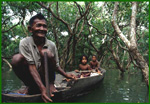
Phluk Kampong Phluk is a cluster of three villages of stilted houses built within the floodplain about 16 km southeast of Siem Reap. The villages are primarily Khmer and have about 3000 inhabitants between them. Flooded mangrove forest surrounds the area and is home to a variety of wildlife including crab-eating macaques. During the dry season when the lake is low, the buildings in the villages seem to soar atop their 6-meter stilts exposed by the lack of water. At this time of year many of the villagers move out onto the lake and build temporary houses. In the wet season when water level rises, the villagers move back to their permanent houses on the floodplain, the stilts now hidden under the water. Kampong Phluk's economy is, as one might expect, based in fishing, primary in shrimp harvesting.
Kampong Phluk sees comparatively few foreign visitors and offers a close look at the submerged forest and lakeside village life. The area can be reached by boat from the Chong Khneas or by road. It’s easiest to make arrangements through a tour operator, or if you are good at bargaining charter a boat at the Chong Khneas docks. During the wet season, drive to Roluos village just off Route #6 east of Siem Reap and then take a boat through the flooded forest the rest of the way. During the dry season the road is clear, making the boat unnecessary.
 Kampong
Khleang
Kampong
Khleang
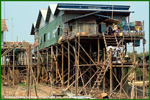
Kampong Khleang is located on the northern lake-edge about 35 km east of Siem Reap. It is more remote and less touristed than Kam-pong Phluk. Visitors during the dry season are universally awestruck by the forest of stilted houses rising up to 10 meters in the air. In the wet season the waters rise to within one or two meters of the buildings. Kampong Khleang is a permanent community within the floodplain of the Lake, with an economy based in fishing and surrounded by flooded forest. But Kampong Khleang is significantly larger with near 10 times the population of Kampong Phluk, making it the largest community on the Lake.
The area can be reached by boat from the Chong Khneas docks or by a combination of road to Domdek on Route #6 and then boat to the village, the best method depending on the time of year. During the dry season, boats cannot get all of the way to the main villages. Consult your guesthouse or tour operator about current conditions. Many tour operators have very little experience in this area so it is best to consult with adventure tour operators and guesthouses that specialize in this area.
To get there yourself, either charter a boat from Chong Khneas or take car or moto to Domdek village on Route #6 east of Siem Reap, turn south and continue to the water's edge where boats wait to ferry passengers into the village. During the dry season the road is clear and you can take a car or moto all of the way to the village.)
Byon temple
Bayon Temple

Like much in the area it dates to the 12th-century reign of King Jayavarman VII, and is particularly noted for its magnificent carved stone faces with their beatific smiles. They depict either the king himself or a bodhisattva; the confusion was probably deliberate.
The bas relief carvings on the temple’s outer walls are a riot of scenes depicting everything from celestial beings and mighty battles to humble village life.
Angkor Wat temple
Angkor Wat (or Angkor Vat), a World Heritage Site,
is a temple at Angkor, Cambodia, built for King Suryavarman II in the
early 12th century as his state temple and capital city. As the
best-preserved temple at the site, it is the only one to have remained a
significant religious centre since its foundation—first Hindu,
dedicated to Vishnu, then Buddhist.
 The
temple is the epitome of the high classical style of Khmer
architecture. It has become a symbol of Cambodia, appearing on its
national flag, and it is the country's prime attraction for visitors.
The
temple is the epitome of the high classical style of Khmer
architecture. It has become a symbol of Cambodia, appearing on its
national flag, and it is the country's prime attraction for visitors.
Angkor Wat combines two basic plans of Khmer temple architecture: the temple mountain and the later galleried temple. It is designed to represent Mount Meru, home of the gods in Hindu mythology: within a moat and an outer wall 3.6 km (2.2 miles) long are three rectangular galleries, each raised above the next.
At the centre of the temple stands a quincunx of towers. Unlike most Angkorian temples, Angkor Wat is oriented to the west; scholars are divided as to the significance of this. The temple is admired for the grandeur and harmony of the architecture, its extensive bas-reliefs and for the numerous devatas (guardian spirits) adorning its walls.
 Angkor Wat is
the prime example of the classical style of Khmer architecture—the
Angkor Wat style—to which it has given its name. By the 12th century
Khmer architects had become skilled and confident in the use of
sandstone (rather than brick or laterite) as the main building material.
Most of the visible areas are of sandstone blocks, while laterite was
used for the outer wall and for hidden structural parts. The binding
agent used to join the blocks is yet to be identified, although natural
resins or slaked lime have been suggested.
Angkor Wat is
the prime example of the classical style of Khmer architecture—the
Angkor Wat style—to which it has given its name. By the 12th century
Khmer architects had become skilled and confident in the use of
sandstone (rather than brick or laterite) as the main building material.
Most of the visible areas are of sandstone blocks, while laterite was
used for the outer wall and for hidden structural parts. The binding
agent used to join the blocks is yet to be identified, although natural
resins or slaked lime have been suggested.
Angkor Wat has drawn praise above all for the harmony of its design, which has been compared to the architecture of ancient Greece or Rome. According to Maurice Glaize, a mid-20th-century conservator of Angkor, the temple "attains a classic perfection by the restrained monumentality of its finely balanced elements and the precise arrangement of its proportions. It is a work of power, unity and style."
 Architecturally,
the elements characteristic of the style include: the ogival, redented
towers shaped like lotus buds; half-galleries to broaden passageways;
axial galleries connecting enclosures; and the cruciform terraces which
appear along the main axis of the temple. Typical decorative elements
are devatas (or apsaras), bas-reliefs, and on pediments extensive
garlands and narrative scenes.
Architecturally,
the elements characteristic of the style include: the ogival, redented
towers shaped like lotus buds; half-galleries to broaden passageways;
axial galleries connecting enclosures; and the cruciform terraces which
appear along the main axis of the temple. Typical decorative elements
are devatas (or apsaras), bas-reliefs, and on pediments extensive
garlands and narrative scenes.
The Angkor Wat style was followed by that of the Bayon period, in which quality was often sacrificed to quantity. Other temples in the style are Banteay Samré, Thommanon, Chao Say Tevoda and the early temples of Preah Pithu at Angkor; outside Angkor, Beng Mealea and parts of Phanom Rung and Phimai.
The
temple is the epitome of the high classical style of Khmer
architecture. It has become a symbol of Cambodia, appearing on its
national flag, and it is the country's prime attraction for visitors.Angkor Wat combines two basic plans of Khmer temple architecture: the temple mountain and the later galleried temple. It is designed to represent Mount Meru, home of the gods in Hindu mythology: within a moat and an outer wall 3.6 km (2.2 miles) long are three rectangular galleries, each raised above the next.
At the centre of the temple stands a quincunx of towers. Unlike most Angkorian temples, Angkor Wat is oriented to the west; scholars are divided as to the significance of this. The temple is admired for the grandeur and harmony of the architecture, its extensive bas-reliefs and for the numerous devatas (guardian spirits) adorning its walls.
Angkor Wat is
the prime example of the classical style of Khmer architecture—the
Angkor Wat style—to which it has given its name. By the 12th century
Khmer architects had become skilled and confident in the use of
sandstone (rather than brick or laterite) as the main building material.
Most of the visible areas are of sandstone blocks, while laterite was
used for the outer wall and for hidden structural parts. The binding
agent used to join the blocks is yet to be identified, although natural
resins or slaked lime have been suggested.Angkor Wat has drawn praise above all for the harmony of its design, which has been compared to the architecture of ancient Greece or Rome. According to Maurice Glaize, a mid-20th-century conservator of Angkor, the temple "attains a classic perfection by the restrained monumentality of its finely balanced elements and the precise arrangement of its proportions. It is a work of power, unity and style."
Architecturally,
the elements characteristic of the style include: the ogival, redented
towers shaped like lotus buds; half-galleries to broaden passageways;
axial galleries connecting enclosures; and the cruciform terraces which
appear along the main axis of the temple. Typical decorative elements
are devatas (or apsaras), bas-reliefs, and on pediments extensive
garlands and narrative scenes.The Angkor Wat style was followed by that of the Bayon period, in which quality was often sacrificed to quantity. Other temples in the style are Banteay Samré, Thommanon, Chao Say Tevoda and the early temples of Preah Pithu at Angkor; outside Angkor, Beng Mealea and parts of Phanom Rung and Phimai.